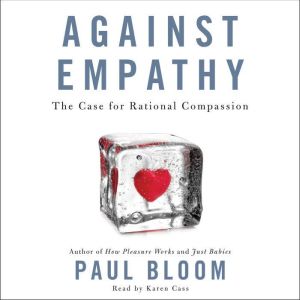
Against Empathy, Paul Bloom
3 Rating(s)
List: $25.99 | Sale: $18.20
Club: $12.99

Against Empathy
The Case for Rational Compassion

Author: Paul Bloom

Narrator: Karen Cass

Unabridged: 7 hr 30 min

Format: Digital Audiobook Download

Publisher: Ecco

Published: 12/06/2016


Synopsis

A controversial call to arms, Against Empathy argues that the natural impulse to share the feelings of others can lead to immoral choices in both public policy and in our intimate relationships with friends and family.Most people, including many policy makers, activists, scientists, and philosophers, have encouraged us to be more empathetic—to feel the pain and pleasure of others. Yale researcher and author Paul Bloom argues that this is a mistake. Far from leading us to improve the lives of others, empathy is a capricious and irrational emotion that appeals to our narrow prejudices. It muddles our judgment and often leads to cruelty. We are at our best when we are smart enough not to rely on it, and draw upon a more distanced compassion. Based on groundbreaking scientific findings, Against Empathy makes the case that some of the worst decisions that individuals and nations make—from who to give money to, when to go to war, how to respond to climate change, and who to put in prison—are too often motivated by honest, yet misplaced, emotions. With clear and witty prose, Bloom demonstrates how empathy distorts our judgment in every aspect of our lives, from philanthropy and charity to the justice system; from culture and education to foreign policy and war. Without empathy, Bloom insists, our decisions would be clearer, fairer, and ultimately more moral.Bound to be controversial, Against Empathy shows us that, when it comes to major policy decisions and the choices we make in our everyday lives, limiting our empathetic emotions is often the most compassionate choice we can make.

About Paul Bloom

Paul Bloom is Professor of Psychology at the University of Toronto, and the Brooks and Suzanne Ragen Professor Emeritus of Psychology at Yale University. His research explores the psychology of morality, identity, and pleasure. Bloom is the recipient of multiple awards and honors, including, most recently, the million-dollar Klaus J. Jacobs Research Prize. He has written for scientific journals such as Nature and Science, and for the New York Times, the New Yorker, and the Atlantic Monthly. He is the author or editor of eight books, including Against Empathy, Just Babies, How Pleasure Works, Descartes’ Baby, and, most recently, The Sweet Spot.


Reviews

Goodreads review by Joachim on February 05, 2017

This was not a very clear, graspable, usable book. There are lots of valid points here and he uses a flood of empirical data. But while he says he hates endless discussions about connotations, I found the explanation and meaning of the title all about linguistic nuance. I actually find the title a bit......more

Goodreads review by Nina (ninjasbooks) on January 22, 2024

Some interesting points in there, but sometimes a boring read. I would also have liked it focusing more on how one could use different approaches than empathy to make decisions. And how one can override those impulses that makes us focus too much on the individual.......more

Goodreads review by Leo on January 27, 2020

I first stumbled on Yale developmental psychologist Paul Bloom reading a New Yorker editorial called The Baby In the Well: The case against empathy. It was an interesting dissection of empathy. Not because it's bad, but because it forces people into crappy decisions. For instance, people across......more

Goodreads review by Blair on July 13, 2018

Hmm, I thought I would enjoy this more than I did – or at least that I would be more stimulated by it than I was. It takes balls to title your book Against Empathy, but that's somewhat undermined by the fact that the author spends so much time reiterating a) what he means by empathy and b) that he i......more

Goodreads review by Charlene on February 21, 2017

Absolutely BRILLIANT! This is a must read for anyone interested in things like: decision-making empathy ingroup/outgroup dynamics policy making social constructs inequality logic v. emotional regulation on a grand scale Why out of 293 Goodreads reviews does this book only have a 3.75? I can't say for sure,......more