1 Rating(s)
List: $29.99
| Sale: $21.00
Club: $14.99
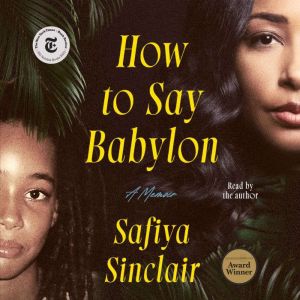
How to Say Babylon
A Memoir
Author: Safiya Sinclair
Narrator: Safiya Sinclair
Unabridged: 16 hr 46 min
Format: Digital Audiobook Download
Publisher: Simon & Schuster Audio
Published: 10/03/2023
Categories: Nonfiction, Biography & Autobiography, Social Science, Women's Studies, Memoirs
Synopsis
National Book Critics Circle Award Winner
A New York Times Notable Book
Best Book of the Year for The Washington Post* The New Yorker * Time * The Atlantic * Los Angeles Times * NPR * Harper’s Bazaar * Vulture * Town & Country * San Francisco Chronicle * Christian Science Monitor * Mother Jones * Barack Obama
A Read with Jenna Today Show Book Club Pick
“Impossible to put down...Each lyrical line sings and soars, freeing the reader as it did the writer.” —People
With echoes of Educated and The Glass Castle, How to Say Babylon is a “lushly observed and keenly reflective chronicle” (The Washington Post), brilliantly recounting the author’s struggle to break free of her rigid religious upbringing and navigate the world on her own terms.
Throughout her childhood, Safiya Sinclair’s father, a volatile reggae musician and a militant adherent to a strict sect of Rastafari, was obsessed with the ever-present threat of the corrupting evils of the Western world outside their home, and worried that womanhood would make Safiya and her sisters morally weak and impure. For him, a woman’s highest virtue was her obedience.
Safiya’s extraordinary mother, though loyal to her father, gave her the one gift she knew would take Safiya beyond the stretch of beach and mountains in Jamaica their family called home: a world of books, knowledge, and education she conjured almost out of thin air. When she introduced Safiya to poetry, Safiya’s voice awakened. As she watched her mother struggle voicelessly for years under relentless domesticity, Safiya’s rebellion against her father’s rules set her on an inevitable collision course with him. Her education became the sharp tool to hone her own poetic voice and carve her path to liberation. Rich in emotion and page-turning drama, How to Say Babylon is “a melodious wave of memories” of a woman finding her own power (NPR).
A New York Times Notable Book
Best Book of the Year for The Washington Post* The New Yorker * Time * The Atlantic * Los Angeles Times * NPR * Harper’s Bazaar * Vulture * Town & Country * San Francisco Chronicle * Christian Science Monitor * Mother Jones * Barack Obama
A Read with Jenna Today Show Book Club Pick
“Impossible to put down...Each lyrical line sings and soars, freeing the reader as it did the writer.” —People
With echoes of Educated and The Glass Castle, How to Say Babylon is a “lushly observed and keenly reflective chronicle” (The Washington Post), brilliantly recounting the author’s struggle to break free of her rigid religious upbringing and navigate the world on her own terms.
Throughout her childhood, Safiya Sinclair’s father, a volatile reggae musician and a militant adherent to a strict sect of Rastafari, was obsessed with the ever-present threat of the corrupting evils of the Western world outside their home, and worried that womanhood would make Safiya and her sisters morally weak and impure. For him, a woman’s highest virtue was her obedience.
Safiya’s extraordinary mother, though loyal to her father, gave her the one gift she knew would take Safiya beyond the stretch of beach and mountains in Jamaica their family called home: a world of books, knowledge, and education she conjured almost out of thin air. When she introduced Safiya to poetry, Safiya’s voice awakened. As she watched her mother struggle voicelessly for years under relentless domesticity, Safiya’s rebellion against her father’s rules set her on an inevitable collision course with him. Her education became the sharp tool to hone her own poetic voice and carve her path to liberation. Rich in emotion and page-turning drama, How to Say Babylon is “a melodious wave of memories” of a woman finding her own power (NPR).

