List: $23.99
| Sale: $16.79
Club: $11.99
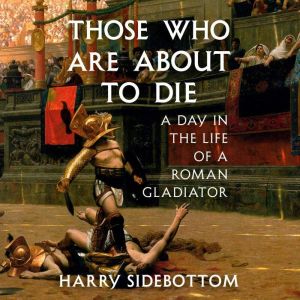
Those Who Are About to Die
A Day in the Life of a Roman Gladiator
Author: Harry Sidebottom
Narrator: Justin Avoth
Unabridged: 10 hr 58 min
Format: Digital Audiobook Download
Publisher: Random House Audio
Published: 04/14/2026
Categories: Nonfiction, Social Science, Violence In Society, Religion, Ancient
Synopsis
ONE OF THE ECONOMIST'S BEST BOOKS OF 2025 • See ancient Rome through the eyes of a gladiator—from the evening before the games at the Colosseum to the evening after
"A grippingly original way of making the alien world of the Roman Amphitheatre both accessible and comprehensible." —Tom Holland, co-host of The Rest is History
What did a gladiator feel when he stepped out onto the sand of the Colosseum, his life in the balance? What ran through the minds of the masses there to witness his likely execution? And how did this bloodthirsty ritual come to exist in the first place?
In Those Who Are About to Die, Harry Sidebottom pulls us into the arena, and into the homes and forums of ancient Rome, taking the reader on an eye-opening, twenty-four-hour tour through Roman life at the height of the gladiatorial games, from the first century BC to the second century AD.
We follow the gladiators through the schools (ludi) where they trained, watch in awe as the massive event unfolds—from the gambling at the pre-festival dinner, to the dawn rush to get a seat in the arena, to the resounding music, the elaborate stage sets, and, yes, the public executions that served as lunch-break entertainment—and we unlearn all the bogus movie tropes (gladiators did not have ripped bods; they were kept fleshy so they’d bleed more).
Broken down by time of day—Vesper, Prima Vigilia, Secunda Vigilia, up through the following sunset (Solis Occasus)—Those Who Are About to Die offers illuminating insights into every aspect of Roman life and thought: their social mores and hierarchies, their feelings about death and sex and violence, and the myths and dreams that fueled the spectacle of the Games.
"A grippingly original way of making the alien world of the Roman Amphitheatre both accessible and comprehensible." —Tom Holland, co-host of The Rest is History
What did a gladiator feel when he stepped out onto the sand of the Colosseum, his life in the balance? What ran through the minds of the masses there to witness his likely execution? And how did this bloodthirsty ritual come to exist in the first place?
In Those Who Are About to Die, Harry Sidebottom pulls us into the arena, and into the homes and forums of ancient Rome, taking the reader on an eye-opening, twenty-four-hour tour through Roman life at the height of the gladiatorial games, from the first century BC to the second century AD.
We follow the gladiators through the schools (ludi) where they trained, watch in awe as the massive event unfolds—from the gambling at the pre-festival dinner, to the dawn rush to get a seat in the arena, to the resounding music, the elaborate stage sets, and, yes, the public executions that served as lunch-break entertainment—and we unlearn all the bogus movie tropes (gladiators did not have ripped bods; they were kept fleshy so they’d bleed more).
Broken down by time of day—Vesper, Prima Vigilia, Secunda Vigilia, up through the following sunset (Solis Occasus)—Those Who Are About to Die offers illuminating insights into every aspect of Roman life and thought: their social mores and hierarchies, their feelings about death and sex and violence, and the myths and dreams that fueled the spectacle of the Games.

