List: $8.99
| Sale: $6.30
Club: $4.49
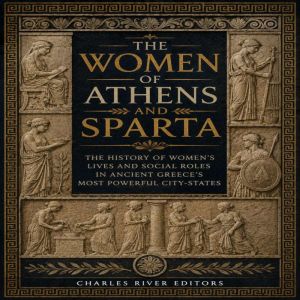
The Women of Athens and Sparta: The History of Women's Lives and Social Roles in Ancient Greece's Most Powerful City-States
Author: Charles River Editors
Narrator: Victoria Woodson
Unabridged: 3 hr 21 min
Format: Digital Audiobook Download
Publisher: Charles River Editors
Published: 05/29/2026
Categories: Nonfiction, History, Greece History, Ancient History, Roman History
Synopsis
Any exploration of the lives of women in Classical Athens has to take into consideration the legal framework which governed such matters as marriage, inheritance and basic rights within society, as well as the woman, herself, within the oikos. However, as a starting point, the simple issues relating to the day to day lives of the women in this period provide an initial understanding of how all of these other factors played a part in the overall pattern of life for at least a Classical Athenian upper class woman. The lives of lower and middle class women, as well as those that did not fall into the defined social hierarchy, were markedly different from that of their aristocratic sisters in some respects. Underlying, however, for all women, was an attitude that sought to keep them apolitical, segregated and secluded as much as was practically possible.Sparta will forever be known for its military prowess, but they had lives off the battlefield as well, and their way of life was also unique. For example, Spartan females were formally educated, which was a rarity among the city-states. Athenian girls were married at 14 to husbands they had never met, whereas Spartan girls married in their late teens or twenties. Athenian women were expected to stay indoors, be segregated from men, remain uneducated, and be silent, while Spartan women trained in athletics, exercised in public in scant clothing or none at all, owned property in their own names, and spoke their minds. By the 4th century B.C., according to Aristotle, they owned 40% of the land across the entire polis, and they were credited by foreign observers with influence over their husbands that no other Greek women possessed. All that can be said for sure is that Sparta had a society in which the female half of the citizen population occupied a position more nearly equal to that of men than anywhere else in the ancient Mediterranean world.