List: $8.99
| Sale: $6.12
Club: $4.49
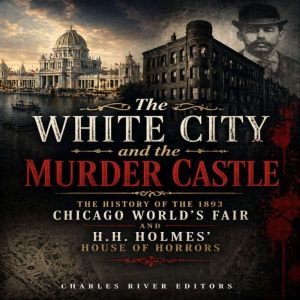
The White City and the Murder Castle: The History of the 1893 Chicago World's Fair and H.H. Holmes' House of Horrors
Author: Charles River Editors
Narrator: Jim Walsh
Unabridged: 2 hr 8 min
Format: Digital Audiobook Download
Publisher: Charles River Editors
Published: 05/07/2026
Categories: Nonfiction, True Crime, Murder
Synopsis
Walking around Chicago today, it’s easy to forget about its past as a rural frontier, which is due in no small part to the way Chicago responded to the Great Fire of 1871. Immediately after the fire, Chicago encouraged inhabitants and architects to build over the ruins, spurring creative architecture with elaborate designs. Architects descended upon the city for the opportunity to rebuild the area, and over the next few decades they had rebuilt Chicago with the country’s most modern architecture and monuments. Chicago recovered well enough within 20 years to win the right to host the 1893 World’s Columbia Exposition, an international fair commemorating the 400th anniversary of Columbus’ discovery of the New World. Covering nearly two square miles, the fairgrounds created a city within a city, and Daniel Burnham was in the middle of it all. With several other noteworthy architects, including Louis Sullivan, Burnham designed the layout of the grounds and the construction of the buildings. During the late 19th century, “neoclassicism” was in vogue, and American architects designed buildings incorporating ancient Greek and Roman architecture. Unfortunately for the international event and some of its guests, today the White City is best known for its association with one of America’s most notorious serial killers. Herman Webster Mudgett was born in 1861 in a small New Hampshire hill town, and he was dead before he turned 35, but in the years between, operating under a name he had constructed to replace his own, he built a hotel in Chicago designed to kill its guests, committed a number of murders whose exact count remains in dispute, and earned the distinction of being among the first Americans to whom the word “serial killer” - a term that did not yet exist in his lifetime - could reasonably be applied.