List: $8.99
| Sale: $6.30
Club: $4.49
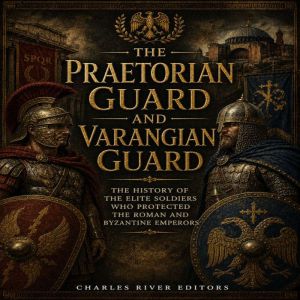
The Praetorian Guard and Varangian Guard: The History of the Elite Soldiers Who Protected the Roman and Byzantine Emperors
Author: Charles River Editors
Narrator: Jim Walsh
Unabridged: 2 hr 47 min
Format: Digital Audiobook Download
Publisher: Charles River Editors
Published: 05/06/2026
Categories: Nonfiction, History, Roman History, Byzantine Empire History, Ancient History
Synopsis
In the late 2nd century B.C., Gaius Marius made the army more professional and helped propel Rome’s expansion, but those same reforms eventually made the legions fiercely loyal to their individual generals rather than the state, which would make Caesar’s seizure of power possible and bring about the dawn of the Roman Empire. Naturally, having military units who were only loyal to individuals also made an imperial bodyguard possible, and few institutions in the long and turbulent history of the Roman Empire characterized the internal dynamics – and potential problems – of the empire’s structure like the Praetorian Guard. The Praetorian Guard was instituted by Augustus as a personal bodyguard for Rome’s most powerful leaders, but it eventually evolved into a kingmaking force that could elevate emperors, manipulate politics, and ultimately weaken the very system it served protect. In that sense, the Praetorian Guard reflected Rome’s transition from a republic that prided itself on civic virtue and suspicion of tyranny into an autocratic empire where the concentration of power in a single individual required both protection and coercion on a scale that didn’t exist before. The most famous of the Byzantine Empire's foreign military units was without question the Varangian Guard. The Varangians came from the land in Eastern Europe known in the Middle Ages as Rus, which is now part of modern Russia and Ukraine. They were descendants of Viking warriors from Sweden who came to rule the waterways and population of Russia. Varangian mercenaries were fighting for the Byzantines by the 10th century, and in 988 they formed a permanent elite guard for the emperor. They took an oath of allegiance to him and served directly under the Acolyte or Akolouthos, who was usually of Byzantine origin. They also assumed responsibilities for the security of Constantinople. They served in battles outside the capital, but usually only when necessity called for it.