List: $19.99
| Sale: $13.99
Club: $9.99
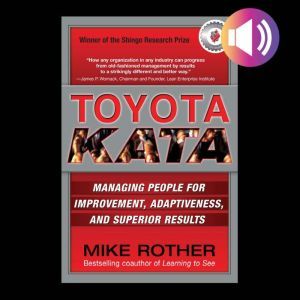
Toyota Kata
Managing People for Improvement, Adaptiveness and Superior Results
Author: Mike Rother
Narrator: Mike Rother
Unabridged: 6 hr 47 min
Format: Digital Audiobook Download
Publisher: McGraw Hill-Ascent Audio
Published: 09/01/2009
Categories: Nonfiction, Business & Economics
Synopsis
"Toyota Kata gets to the essence of how Toyota manages continuous improvement and human ingenuity, through its improvement kata and coaching kata. Mike Rother explains why typical companies fail to understand the core of lean and make limited progress-and what it takes to make it a real part of your culture."
-Jeffrey K. Liker, bestselling author of The Toyota Way "[Toyota Kata is] one of the stepping stones that will usher in a new era of management thinking."
-The Systems Thinker
"How any organization in any industry can progress from old-fashioned management by results to a strikingly different and better way."
-James P. Womack, Chairman and Founder, Lean Enterprise Institute
"Practicing the improvement kata is perhaps the best way we've found so far for actualizing PDCA in an organization."
-John Shook, Chairman and CEO, Lean Enterprise Institute
This game-changing book puts you behind the curtain at Toyota, providing new insight into the legendary automaker's management practices and offering practical guidance for leading and developing people in a way that makes the best use of their brainpower.
Drawing on six years of research into Toyota's employee-management routines, Toyota Kata examines and elucidates, for the first time, the company's organizational routines--called kata--that power its success with continuous improvement and adaptation. The book also reaches beyond Toyota to explain issues of human behavior in organizations and provide specific answers to questions such as:
How can we make improvement and adaptation part of everyday work throughout the organization?
How can we develop and utilize the capability of everyone in the organization to repeatedly work toward and achieve new levels of performance?
How can we give an organization the power to handle dynamic, unpredictable situations and keep satisfying customers?
Mike Rother explains how to improve our prevailing management approach through the use of two kata: Improvement Kata--a repeating routine of establishing challenging target conditions, working step-by-step through obstacles, and always learning from the problems we encounter; and Coaching Kata: a pattern of teaching the improvement kata to employees at every level to ensure it motivates their ways of thinking and acting.
With clear detail, an abundance of practical examples, and a cohesive explanation from start to finish, Toyota Kata gives executives and managers at any level actionable routines of thought and behavior that produce superior results and sustained competitive advantage.
-Jeffrey K. Liker, bestselling author of The Toyota Way "[Toyota Kata is] one of the stepping stones that will usher in a new era of management thinking."
-The Systems Thinker
"How any organization in any industry can progress from old-fashioned management by results to a strikingly different and better way."
-James P. Womack, Chairman and Founder, Lean Enterprise Institute
"Practicing the improvement kata is perhaps the best way we've found so far for actualizing PDCA in an organization."
-John Shook, Chairman and CEO, Lean Enterprise Institute
This game-changing book puts you behind the curtain at Toyota, providing new insight into the legendary automaker's management practices and offering practical guidance for leading and developing people in a way that makes the best use of their brainpower.
Drawing on six years of research into Toyota's employee-management routines, Toyota Kata examines and elucidates, for the first time, the company's organizational routines--called kata--that power its success with continuous improvement and adaptation. The book also reaches beyond Toyota to explain issues of human behavior in organizations and provide specific answers to questions such as:
How can we make improvement and adaptation part of everyday work throughout the organization?
How can we develop and utilize the capability of everyone in the organization to repeatedly work toward and achieve new levels of performance?
How can we give an organization the power to handle dynamic, unpredictable situations and keep satisfying customers?
Mike Rother explains how to improve our prevailing management approach through the use of two kata: Improvement Kata--a repeating routine of establishing challenging target conditions, working step-by-step through obstacles, and always learning from the problems we encounter; and Coaching Kata: a pattern of teaching the improvement kata to employees at every level to ensure it motivates their ways of thinking and acting.
With clear detail, an abundance of practical examples, and a cohesive explanation from start to finish, Toyota Kata gives executives and managers at any level actionable routines of thought and behavior that produce superior results and sustained competitive advantage.


