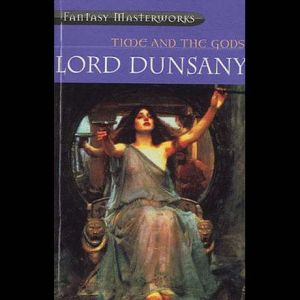
Time and the Gods, Lord Dunsany
14 Rating(s)
$0.00

Time and the Gods

Author: Lord Dunsany

Narrator: Unknown

Unabridged: 2 hr 48 min

Format: Digital Audiobook Download

Published: Not Available


Synopsis

Lord Dunsany (24 July 1878 25 October 1957) was a London-born Anglo-Irish writer and dramatist notable for his work in fantasy. He was influenced by Algernon Swinburne, who wrote the line Time and the Gods are at strife in his 1866 poem Hymn to Proserpine, as well as by the fairy tales of the Brothers Grimm and Hans Christian Andersen. In turn, Dunsanys influence was felt by H. P. Lovecraft and Ursula K. Le Guin. Arthur C. Clarke corresponded with Dunsany between 1944 and 1956. Those letters are collected in the book Arthur C. Clarke & Lord Dunsany: A Correspondence. Time and the Gods, a series of short stories written in a myth-like style, was first published in 1906.

About Lord Dunsany

Lord Dunsany was born in London in 1878, the scion of an Anglo-Irish family that could trace its ancestry to the twelfth century. In 1905 he self-published The Gods of Pegana, and its critical and popular success impelled the publication of numerous other collections of short stories, including A Dreamer's Tales, The Book of Wonder, and The Last Book of Wonder. Dunsany also distinguished himself as a dramatist, and his early plays-collected in Five Plays and Plays of Gods and Men-were successful in Ireland, England, and the United States. Dunsany was seriously injured during the Dublin riots of 1916, and he also saw action in World War I as a member of the Coldstream Guards.

In the 1920s Dunsany began writing novels, among them The King of Elfland's Daughter and The Blessing of Pan. He also wrote many tales of the loquacious clubman Joseph Jorkens, eventually collected in five volumes. His later plays include If, Plays of Near and Far, Seven Modern Comedies, and Plays for Earth and Air. By the 1930s, encouraged by W. B. Yeats and others to write about his native Ireland, he produced The Curse of the Wise Woman, The Story of Mona Sheehy, and other novels. His later tales were gathered in The Man Who Ate the Phoenix and The Little Tales of Smethers, but many works remain uncollected. Lord Dunsany died at Dunsany Castle in County Meath, Ireland, in 1957. He is recognized as a leading figure in the development of modern fantasy literature, influencing such writers as J. R. R. Tolkien, H. P. Lovecraft, and Ursula K. Le Guin.


Reviews

There are currently no user reviews for this audiobook.