List: $33.99
| Sale: $23.80
Club: $16.99
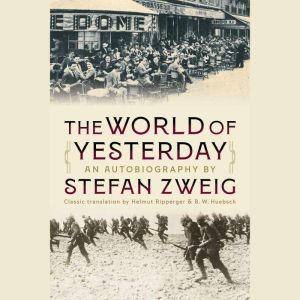
The World of Yesterday - An Autobiography
Classic Translation by Helmut Ripperger and B.W. Huebsch
Author: Stefan Zweig
Narrator: Grover Gardner
Unabridged: 16 hr 44 min
Format: Digital Audiobook Download
Publisher: Maple Spring Publishing
Published: 08/11/2026
Categories: Fiction, World Literature, Literary Fiction, Classic
Synopsis
It’s been said that the past is another country. Stefan Zweig’s memoir The World of Yesterday takes readers into several such countries.
This book has been called the most famous work about the Hapsburg Empire of Austria-Hungary (which Zweig calls “the world of security”) in the last decades before its collapse in the First World War. Zweig, an Austrian Jew born and raised in Vienna in 1881, pays a haunting tribute to his vanished nation in this memoir, completed just before his death. He opens by describing a comfortable childhood in bourgeois Vienna; a dismal and discouraging educational system; student life, with its duels and drinking; and the furtive and repressed sexuality of the early twentieth century.
Zweig goes on to talk about his lifelong encounters with great writers, thinkers, and artists, such as Sigmund Freud, Auguste Renoir, Romain Rolland, and Rainer Maria Rilke, many of whom he counted as close friends.
Zweig reached the height of his success in the 1920s and 1930s, when he was one of the world’s most widely read literary figures, with numerous biographies and fictional works such as Letter from an Unknown Woman and Beware of Pity.
But the shadow of Nazism was falling over Central Europe at that time, and in 1933, Zweig’s works were banned by the Third Reich. When Germany annexed Austria in 1938, his fled his native country, moving first to England, then to the United States, and finally to Brazil, where he and his wife committed joint suicide in 1942. In his farewell note, he wrote, “I think it better to conclude in good time and in erect bearing a life in which intellectual labour meant the purest joy and personal freedom the highest good on earth.”
Zweig’s memoir—moving, insightful, sensitive, and historically rich—was completed shortly before his death. It recalls to memory a shimmering, vibrant, but doomed Europe over a century ago.
This book has been called the most famous work about the Hapsburg Empire of Austria-Hungary (which Zweig calls “the world of security”) in the last decades before its collapse in the First World War. Zweig, an Austrian Jew born and raised in Vienna in 1881, pays a haunting tribute to his vanished nation in this memoir, completed just before his death. He opens by describing a comfortable childhood in bourgeois Vienna; a dismal and discouraging educational system; student life, with its duels and drinking; and the furtive and repressed sexuality of the early twentieth century.
Zweig goes on to talk about his lifelong encounters with great writers, thinkers, and artists, such as Sigmund Freud, Auguste Renoir, Romain Rolland, and Rainer Maria Rilke, many of whom he counted as close friends.
Zweig reached the height of his success in the 1920s and 1930s, when he was one of the world’s most widely read literary figures, with numerous biographies and fictional works such as Letter from an Unknown Woman and Beware of Pity.
But the shadow of Nazism was falling over Central Europe at that time, and in 1933, Zweig’s works were banned by the Third Reich. When Germany annexed Austria in 1938, his fled his native country, moving first to England, then to the United States, and finally to Brazil, where he and his wife committed joint suicide in 1942. In his farewell note, he wrote, “I think it better to conclude in good time and in erect bearing a life in which intellectual labour meant the purest joy and personal freedom the highest good on earth.”
Zweig’s memoir—moving, insightful, sensitive, and historically rich—was completed shortly before his death. It recalls to memory a shimmering, vibrant, but doomed Europe over a century ago.