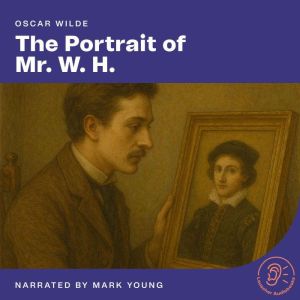
The Portrait of Mr. W. H., Oscar Wilde
List: $5.49 | Sale: $3.85
Club: $2.74

The Portrait of Mr. W. H.

Author: Oscar Wilde

Narrator: Mark Young

Unabridged: 1 hr 4 min

Format: Digital Audiobook Download

Published: 01/29/2026

Categories: Fiction, Classic


Synopsis

"The Portrait of Mr. W. H." is a story written by Oscar Wilde, first published in Blackwood's Magazine in 1889. It was later added to the collection Lord Arthur Savile's Crime and Other Stories, though it does not appear in early editions. An enlarged edition planned by Wilde, almost twice as long as the Blackwood's version, with cover illustration by Charles Ricketts, did not proceed and only came to light after Wilde's death. This was published in limited edition by Mitchell Kennerley in New York in 1921, and in a first regular English edition by Methuen in 1958, edited by Vyvyan Holland. Wilde's story is narrated by a friend of a man called Erskine, who is preoccupied by the Hughes theory. Erskine had learned the idea from one Cyril Graham, who had tried to persuade Erskine of it based on the text of the sonnets, but Erskine was frustrated by the lack of external historical evidence for Willie Hughes's existence. Graham tried to find such evidence but failed; instead, he fakes a portrait of Hughes in which Hughes is depicted with his hand on a book on which can be seen the dedication from the sonnets. Erskine is convinced by this evidence, but then discovers the portrait to be a fake, a discovery that leads him to yet again doubt the existence of Willie Hughes. Graham still believes in the theory, and to prove it, shoots himself.

About Oscar Wilde

Oscar Wilde was born in Dublin on October 16, 1854. He excelled at Trinity College in Dublin from 1871 to 1874, eventually winning a scholarship to Magdalene College in Oxford, which he entered in 1875. The biggest influences on his development as an artist at this time were Swinburne, Walter Pater, and John Ruskin.

In 1875, Wilde began publishing poetry in literary magazines. In 1876 he found himself back in Ireland when the death of his father left the family with several debts. Wilde continued writing poetry in earnest, and in 1878, he won the coveted Newdigate Prize for English poetry. He soon left Oxford to build himself a reputation among the literati in London.

During the 1880s, Wilde established himself as a writer, poet, and lecturer, but above all as a "professor of aesthetics." In 1884, he married Constance Lloyd in London. Sons soon followed: Cyril in 1885 and Vyvyan in 1886. During these years, Wilde worked as a journalist and reviewer, while also continuing with his other writing of poetry and plays. In 1890 he published his well-known story The Picture of Dorian Gray. The early 1890s were the most intellectually productive and fruitful time for Wilde. Some of his most familiar plays-including Lady Windemere's Fan and Salome-were written and performed upon the London stages. In 1893 Wilde produced A Woman of No Importance and An Ideal Husband, followed in 1894 by The Importance of Being Earnest.

Wilde's life took a turn for the worst when, in May 1895, he was convicted of engaging in homosexual acts, which were then illegal, and sentenced to two years imprisonment with hard labor. He soon declared bankruptcy, and his property was auctioned off. In 1896, Wilde lost legal custody of his children. When his mother died that same year, his wife Constance visited him at the jail to bring him the news. It was the last time they saw each other. In the years after his release, Wilde's health deteriorated. In November 1900, he died in Paris at the age of forty-six.


Reviews

There are currently no user reviews for this audiobook.