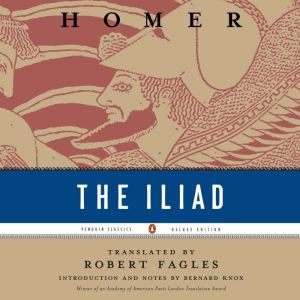
The Iliad, Homer
The Iliad, Homer
9 Rating(s)
List: $32.00 | Sale: $22.40
Club: $16.00

The Iliad

Author: Homer, Robert Fagles

Narrator: Vidish Athavale

Unabridged: 21 hr 11 min

Format: Digital Audiobook Download

Publisher: Penguin Audio

Published: 06/03/2025

Includes: Bonus Material Bonus Material Included


Synopsis

This translation of The Iliad equals Fitzgerald's earlier Odyssey in power and imagination. It recreates the original action as conceived by Homer, using fresh and flexible blank verse that is both lyrical and dramatic.

* This audiobook edition includes a downloadable PDF containing Notes on the Translation and Suggestions for Further Reading from the book.

About The Author

Seven Greek cities claim the honor of being the birthplace of Homer (c. 8th–7th century BC), the poet to whom the composition of the Iliad and the Odyssey are attributed. The Iliad is the oldest surviving work of Western literature, but the identity—or even the existence—of Homer himself is a complete mystery, with no reliable biographical information having survived.E. V. Rieu initiated Penguin Classics with Allen Lane, and his famous translation of the Odyssey was the first book published in the series in 1947. The Iliad followed in 1950.Coralie Bickford-Smith is an award-winning designer at Penguin Books, where she has created several highly acclaimed series designs. She studied typography at Reading University and lives in London.


Reviews

Goodreads review by Grace Tjan on December 04, 2013

What I learned from this book (in no particular order): 1. Victory or defeat in ancient Greek wars is primarily the result of marital spats and/or petty sibling rivalry in Zeus and Hera’s dysfunctional divine household. 2. Zeus “the father of gods and men” is a henpecked husband who is also partial to......more

Goodreads review by emma on April 30, 2023

welcome to...THE APRILIAD! for those of you who are new here and do not yet feel the existential dread and heart-stopping moroseness that a title + month pun inspires in the hearts of many... 1) hi. and 2) you have been cursed to stumble upon yet another installment of PROJECT LONG CLASSICS, in which......more

Goodreads review by Emily May on January 05, 2019

3½ stars Two mysteries were solved by my finally finishing The Iliad. 1) It is so obvious why these Ancient Greek stories have survived for so many years-- it's all gory violence and sex. Homer tapped into these marketing tools early. 2) I now understand why puritanical attitudes toward female sexua......more

Goodreads review by J.G. Keely on June 30, 2009

Pablo Picasso spent his entire life trying desperately to do something new, something unique. He moved from style to style, mastering and then abandoning both modern and classical methods, even trying to teach his trained artist's hand to paint like a child. In 1940, four French teens and a dog stumb......more

Goodreads review by Persephone's Pomegranate on January 21, 2024

Achilles - sexually ambiguous, rage-prone, has a sensitive tendon. Patroclus - 'best friend' of Achilles. Ruined everything for everyone. Odysseus - outsmarted the Trojans, had sex with a witch and a nymph. Agamemnon - worst husband, worst father, worst Greek, worst human. Menelaus - lost......more


Quotes

“Fitzgerald has solved virtually every problem that has plagued translators of Homer. The narrative runs, the dialogue speaks, the military action is clear, and the repetitive epithets become useful text rather than exotic relics.” –Atlantic Monthly

“Fitzgerald’s swift rhythms, bright images, and superb English make Homer live as never before…This is for every reader in our time and possibly for all time.”–Library Journal

“[Fitzgerald’s Odyssey and Iliad] open up once more the unique greatness of Homer’s art at the level above the formula; yet at the same time they do not neglect the brilliant texture of Homeric verse at the level of the line and the phrase.” –The Yale Review

“What an age can read in Homer, what its translators can manage to say in his presence, is one gauge of its morale, one index to its system of exultations and reticences. The supple, the iridescent, the ironic, these modes are among our strengths, and among Mr. Fitzgerald’s.” –National Review

With an Introduction by Gregory Nagy