List: $9.99
| Sale: $7.00
Club: $4.99
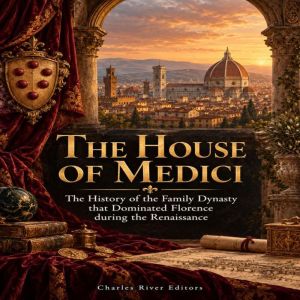
The House of Medici: The History of the Family Dynasty that Dominated Florence during the Renaissance
Author: Charles River Editors
Narrator: Victoria Woodson
Unabridged: 6 hr 22 min
Format: Digital Audiobook Download
Publisher: Charles River Editors
Published: 11/05/2026
Synopsis
Most historians credit the city-state of Florence as the place that started and developed the Italian Renaissance, a process carried out through the patronage and commission of artists during the late 12th century. If Florence has received its due credit, much of it belongs to the House of Medici, the family dynasty of Florence that ruled at the height of the Renaissance. The dynasty held such influence that some of its family members even became pope, and it all started with a banker colloquially known as Cosimo the Elder. The peace and the wars of Italy answered to his judgment, and the powerful leaders across the peninsula carried their business to his house, settling across a banker’s table the questions other cities settled in council chambers and throne rooms. The main instrument of that power was money, and the source of the money was a bank. The Medici bank, built by Cosimo the Elder’s father and brought to its height by Cosimo himself, became the most profitable financial house in Europe. The Medici bank would work with popes and princes, with branches reaching from Florence to Rome, Venice, Geneva, Lyon, Bruges, and London. From this foundation, Cosimo did something that no merchant before him had managed on such a scale by turning wealth into culture and culture into permanence. He paid for the libraries, the convents, the palaces, the bronzes, and the manuscripts that gave the Renaissance much of its physical form, and he gathered the scholars and artists whose work defined the age. Among all of the Medicis, its most famous member ruled during the Golden Age of Florence at the apex of the Renaissance’s artistic achievements. Lorenzo de Medici, commonly referred to as Lorenzo the Magnificent, was groomed both intellectually and politically to rule Venice, and he took the reins of power at just 20 years old. Of all the fields that were advanced during the Renaissance, the period’s most famous works were art, with iconic paintings and timeless sculptures.