List: $17.99
| Sale: $12.59
Club: $8.99
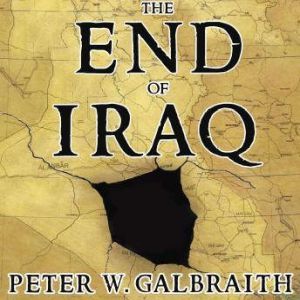
The End of Iraq
How American Incompetence Created a War Without End
Author: Peter W. Galbraith
Narrator: Alan Sklar
Unabridged: 9 hr 35 min
Format: Digital Audiobook Download
Publisher: Tantor Media
Published: 09/16/2008
Categories: Nonfiction, Military History, History, Modern History
Synopsis
The United States invaded Iraq with grand ambitions to bring it democracy and thereby transform the Middle East. Instead, Iraq has disintegrated into three constituent components: a pro-western Kurdistan in the north, an Iran-dominated Shiite entity in the south, and a chaotic Sunni Arab region in the center. The country is plagued by insurgency and is in the opening phases of a potentially catastrophic civil war.
George W. Bush broke up Iraq when he ordered its invasion in 2003. The United States not only removed Saddam Hussein, it also smashed and later dissolved the institutions by which Iraq's Sunni Arab minority ruled the country: its army, its security services, and the Baath Party. With these institutions gone and irreplaceable, the basis of an Iraqi state has disappeared.
The End of Iraq describes the administration's strategic miscalculations behind the war as well as the blunders of the American occupation. There was the failure to understand the intensity of the ethnic and religious divisions in Iraq. This was followed by incoherent and inconsistent strategies for governing, the failure to spend money for reconstruction, the misguided effort to create a national army and police, and then the turning over of the country's management to Republican political loyalists rather than qualified professionals. As a matter of morality, Peter W. Galbraith writes, the Kurds of Iraq are no less entitled to independence than are Lithuanians, Croatians, or Palestinians. And if the country's majority Shiites want to run their own affairs, or even have their own state, on what democratic principle should they be denied?
If the price of a unified Iraq is another dictatorship, Galbraith writes, it is too high a price to pay. The United States must now focus not on preserving or forging a unified Iraq but on avoiding a spreading and increasingly dangerous and deadly civil war. It must accept the reality of Iraq's breakup and work with Iraq's Shiites, Kurds, and Sunni Arabs to strengthen the already semi-independent regions. If they are properly constituted, these regions can provide security, though not all will be democratic. There is no easy exit from Iraq for America. We have to relinquish our present strategy—trying to build national institutions when there is, in fact, no nation. That effort is doomed, Galbraith argues, and it will only leave the United States with an open-ended commitment in circumstances of uncontrollable turmoil.
Galbraith has been in Iraq many times over the last twenty-one years during historic turning points for the country: the Iran-Iraq War, the Kurdish genocide, the 1991 uprising, the immediate aftermath of the 2003 war, and the writing of Iraq's constitutions. In The End of Iraq, he offers many firsthand observations of the men who are now Iraq's leaders. He draws on his nearly two decades of involvement in Iraq policy working for the U.S. government to appraise what has occurred and what will happen. The End of Iraq is the definitive account of this war and its ramifications.
George W. Bush broke up Iraq when he ordered its invasion in 2003. The United States not only removed Saddam Hussein, it also smashed and later dissolved the institutions by which Iraq's Sunni Arab minority ruled the country: its army, its security services, and the Baath Party. With these institutions gone and irreplaceable, the basis of an Iraqi state has disappeared.
The End of Iraq describes the administration's strategic miscalculations behind the war as well as the blunders of the American occupation. There was the failure to understand the intensity of the ethnic and religious divisions in Iraq. This was followed by incoherent and inconsistent strategies for governing, the failure to spend money for reconstruction, the misguided effort to create a national army and police, and then the turning over of the country's management to Republican political loyalists rather than qualified professionals. As a matter of morality, Peter W. Galbraith writes, the Kurds of Iraq are no less entitled to independence than are Lithuanians, Croatians, or Palestinians. And if the country's majority Shiites want to run their own affairs, or even have their own state, on what democratic principle should they be denied?
If the price of a unified Iraq is another dictatorship, Galbraith writes, it is too high a price to pay. The United States must now focus not on preserving or forging a unified Iraq but on avoiding a spreading and increasingly dangerous and deadly civil war. It must accept the reality of Iraq's breakup and work with Iraq's Shiites, Kurds, and Sunni Arabs to strengthen the already semi-independent regions. If they are properly constituted, these regions can provide security, though not all will be democratic. There is no easy exit from Iraq for America. We have to relinquish our present strategy—trying to build national institutions when there is, in fact, no nation. That effort is doomed, Galbraith argues, and it will only leave the United States with an open-ended commitment in circumstances of uncontrollable turmoil.
Galbraith has been in Iraq many times over the last twenty-one years during historic turning points for the country: the Iran-Iraq War, the Kurdish genocide, the 1991 uprising, the immediate aftermath of the 2003 war, and the writing of Iraq's constitutions. In The End of Iraq, he offers many firsthand observations of the men who are now Iraq's leaders. He draws on his nearly two decades of involvement in Iraq policy working for the U.S. government to appraise what has occurred and what will happen. The End of Iraq is the definitive account of this war and its ramifications.


