List: $26.99
| Sale: $18.89
Club: $13.49
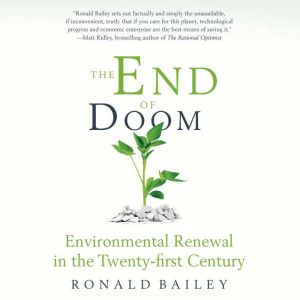
The End of Doom
Environmental Renewal in the Twenty-first Century
Author: Ronald Bailey
Narrator: AI Voice
Unabridged: 9 hr 16 min
Format: Digital Audiobook Download
Publisher: Macmillan Audio
Published: 11/18/2025
Synopsis
This program is read by an AI-based synthesized voice.
In the past five decades there have been many, many forecasts of impending environmental doom. They have universally been proven wrong. Meanwhile, those who have bet on human resourcefulness have almost always been correct.
In his widely praised book Ecoscam, Ronald Bailey strongly countered environmentalist alarmism, using facts to demonstrate just how wildly overstated many claims of impending ecological doom really were. Now, twenty years later, the Reason Magazine science correspondent is back to assess the future of humanity and the global biosphere. Bailey finds, contrary to popular belief, that many present ecological trends are quite positive. Including:
Falling cancer incidence rates in the United States.
The likelihood of a declining world population by mid-century.
The abundant return of agricultural land to nature as the world reaches peak farmland.
A proven link between increases in national wealth and reductions in air and water pollution
Global warming is a problem, but the cost of clean energy could soon fall below that of fossil fuels.
In The End of Doom, Bailey avoids polemics and offers a balanced, fact-based and ultimately hopeful perspective on our current environmental situation. Now isn't that a breath of fresh air?
In the past five decades there have been many, many forecasts of impending environmental doom. They have universally been proven wrong. Meanwhile, those who have bet on human resourcefulness have almost always been correct.
In his widely praised book Ecoscam, Ronald Bailey strongly countered environmentalist alarmism, using facts to demonstrate just how wildly overstated many claims of impending ecological doom really were. Now, twenty years later, the Reason Magazine science correspondent is back to assess the future of humanity and the global biosphere. Bailey finds, contrary to popular belief, that many present ecological trends are quite positive. Including:
Falling cancer incidence rates in the United States.
The likelihood of a declining world population by mid-century.
The abundant return of agricultural land to nature as the world reaches peak farmland.
A proven link between increases in national wealth and reductions in air and water pollution
Global warming is a problem, but the cost of clean energy could soon fall below that of fossil fuels.
In The End of Doom, Bailey avoids polemics and offers a balanced, fact-based and ultimately hopeful perspective on our current environmental situation. Now isn't that a breath of fresh air?