List: $6.99
| Sale: $4.90
Club: $3.49
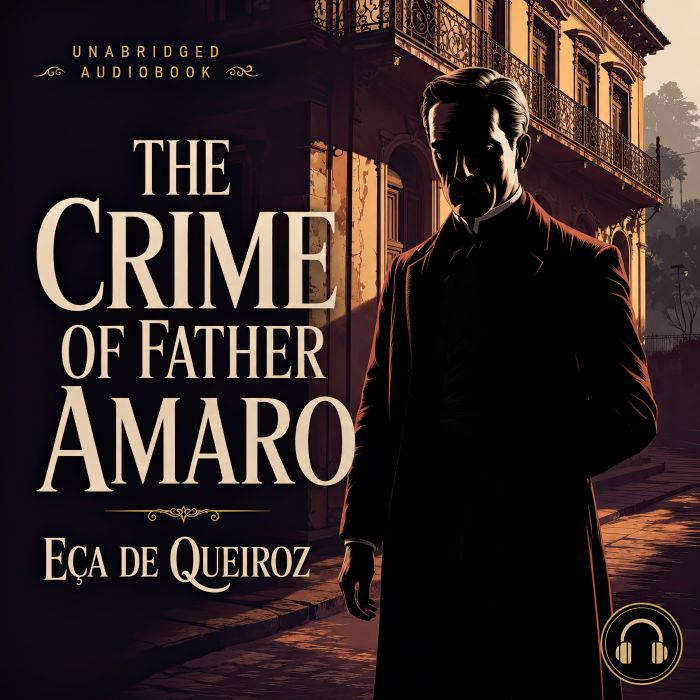
The Crime Of Father Amaro
Author: Eça de Queiroz
Narrator: AI Voice Charles Owen
Unabridged: 18 hr 10 min
Format: Digital Audiobook Download
Publisher: Independently Published
Published: 07/10/2026
Categories: Fiction, World Literature
Synopsis
This audiobook is narrated by an AI Voice. Father Amaro arrives in the provincial Portuguese town of Leiria without a vocation. He became a priest because he was an orphan in the care of a noblewoman who directed her charity toward the seminary, because the seminary was the institution available to a boy of no means and no family, because ordination was the end of a process that had never asked him what he actually was. He has the appearance and the social position of a priest. He has the appetites and the unresolved nature of a man. The gap between these two facts is where the novel lives.
Amélia is his landlady's daughter, pious in the way the Church had been cultivating female piety for generations — as intense emotional feeling organized around devotional objects that the Church provided and controlled. When a young priest arrives who is handsome and attentive and inhabits the spiritual authority around which her feeling has always gathered, what follows is not a simple seduction. It is the logical outcome of an entire religious culture's management of desire.
Eça de Queiroz published The Crime of Father Amaro in its definitive form in 1880, the opening salvo of the Geração de 70 — the Generation of 1870's project to modernize Portuguese culture through engagement with European liberalism and scientific thought — and it remains the most ferociously precise work of literary anticlericalism in the Portuguese tradition. It is the Church's crime in the systemic sense: the same institutional arrangements that produced the situation protect its perpetrator and leave its victims without recourse.
One of the great overlooked masterworks of European naturalism — precise, ferocious, and as structurally honest as any novel of its century.
Amélia is his landlady's daughter, pious in the way the Church had been cultivating female piety for generations — as intense emotional feeling organized around devotional objects that the Church provided and controlled. When a young priest arrives who is handsome and attentive and inhabits the spiritual authority around which her feeling has always gathered, what follows is not a simple seduction. It is the logical outcome of an entire religious culture's management of desire.
Eça de Queiroz published The Crime of Father Amaro in its definitive form in 1880, the opening salvo of the Geração de 70 — the Generation of 1870's project to modernize Portuguese culture through engagement with European liberalism and scientific thought — and it remains the most ferociously precise work of literary anticlericalism in the Portuguese tradition. It is the Church's crime in the systemic sense: the same institutional arrangements that produced the situation protect its perpetrator and leave its victims without recourse.
One of the great overlooked masterworks of European naturalism — precise, ferocious, and as structurally honest as any novel of its century.