List: $8.99
| Sale: $6.30
Club: $4.49
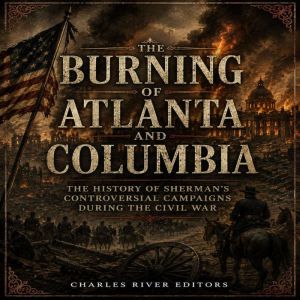
The Burning of Atlanta and Columbia: The History of Sherman's Controversial Campaigns during the Civil War
Author: Charles River Editors
Narrator: Jim Walsh
Unabridged: 2 hr 44 min
Format: Digital Audiobook Download
Publisher: Charles River Editors
Published: 08/21/2026
Categories: Nonfiction, History, Us History, Children's Nonfiction, Young Adult Nonfiction
Synopsis
General William Tecumseh Sherman has earned fame and infamy for being the one to bring total war to the South, and it started at Atlanta. Once his men entered the city, Sherman ordered the 1,600 citizens remaining in Atlanta to evacuate the city as he, in Grant’s words, set out to “destroy [Atlanta] so far as to render it worthless for military purposes,” with Sherman himself remaining a day longer to supervise the destruction himself “and see that it was well done.” Then on November 14, 1864, Sherman abandoned the ravaged city, taking with him thirteen thousand mules and horses and all the supplies the animals could carry. One of the most famous movies of all time, Gone With The Wind, depicts the burning of Atlanta after Sherman occupied it in 1864. Over time, history came to view Sherman as a harbinger of total war, and in the South, Sherman is still viewed as a brutal warmonger. Thanks to Sherman’s campaigns in Georgia, it is often forgotten that his army was involved in another controversial incident that happened near the end of the Civil War in South Carolina, the first state to secede from the Union. On the night of February 17, 1865, Columbia went up in flames shortly after it had surrendered to Sherman, and whereas Atlanta’s losses were planned and premeditated, focusing primarily on the industrial buildings and railyards, Columbia’s burning was largely uncontrolled, with residential neighborhoods suffering greatly and the commercial district being entirely wiped out. The fire was also accompanied by a riot carried out by drunken and disorderly mobs of Union troops looting the city and assaulting residents. After this chaos gutted Columbia, there came a more regulated incineration of the capital’s industrial district. Sherman’s army then left the city in ruins and its citizens struggling to process what had just happened.