List: $3.99
| Sale: $2.80
Club: $1.99
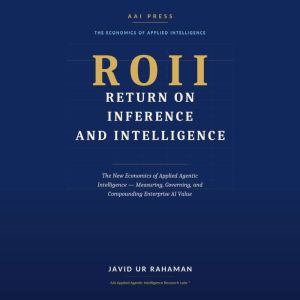
ROII: Return on Inference and Intelligence
The New Economics of Applied Agentic Intelligence — Measuring, Governing, and Compounding Enterprise AI Value
Author: Javid Ur Rahaman
Series: ROII Return on Inference & Intelligence Book Series
Narrator: AI Voice Puck
Unabridged: 9 hr 40 min
Format: Digital Audiobook Download
Publisher: AAI Press
Published: 10/07/2026
Categories: Nonfiction, Business & Economics, Corporate Finance
Includes:
Bonus Material

Synopsis
This audiobook is narrated by an AI Voice.
The spend is precise. The return is a slide.
Every board has approved artificial intelligence spending it cannot yet defend. The invoices are exact to the cent. The benefits arrive as a slide.
That gap is not a technology failure and it is not a spending failure. It is a measurement failure. The enterprise still books intelligence the way it booked software — a capitalized build with a payback date — when what it bought is a consumable capability metered by the inference.
ROII names it, then supplies the instrument. It treats Return on Inference and Intelligence as a defined ratio rather than a rhetorical one: two auditable ledgers, a stated standard of proof, and a four-page report a director can challenge.
The Cost Ledger prices intelligence across four layers — Model, Motion, Machinery and Minding. The layers roll into an Inference P&L and reduce to one management metric: cost per resolved outcome, the cost of an outcome the enterprise actually wanted, failures on the way included.
The Return Ledger sorts benefit into three horizons — Deflection, work not done; Elevation, work done better; Creation, work newly possible — each with its own standard of proof and its own characteristic overclaim.
The book's temper is its second argument. Most writing on enterprise AI is advocacy. This is closer to an audit.
This is Volume One of two, and it is the argument. It is complete on its own.
For chief financial officers and finance leadership, chief executives and directors, chief AI officers, enterprise architects and the advisors who must put a number on all of it.
The economics companion to "The Architect of Enterprise."
This book is analysis and management commentary. It is not investment, accounting, tax or legal advice.