List: $22.99
| Sale: $16.09
Club: $11.49
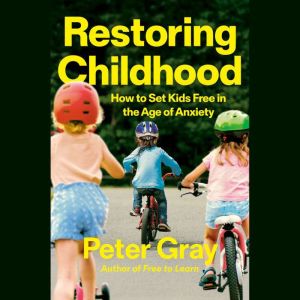
Restoring Childhood
How to Set Kids Free in the Age of Anxiety
Author: Peter Gray
Narrator: Peter Gray
Unabridged: TBD
Format: Digital Audiobook Download
Publisher: Penguin Audio
Published: 09/15/2026
Categories: Nonfiction, Family & Relationships, Parenting
Synopsis
What if the cause of the youth mental health crisis wasn’t social media at all?
When was the last time you actually saw a group of kids—without adults—playing on a playground? Forty years ago, an American ten-year-old could expect to walk to school, bike to a friend’s, or play pick-up games with other kids in the neighborhood. Today, our children are supervised and controlled at every opportunity.
As author, researcher, and psychology professor Peter Gray shows in Restoring Childhood, kids aren’t depressed and anxious because of social media. They’re retreating to social media in large part because they lack agency and autonomy in the real world. Social media use is instead often a symptom of the larger problem: the disappearance of childhood as a stage of life solely for experimentation, play, and learning you can do things on your own. And if we continue to tighten the leash on our kids, no amount of screen-time restriction will reverse the alarming mental health crisis we see our kids enduring today.
Restoring Childhood is a radical examination of how certain societal trends—from round-the-clock news coverage, to increasing reliance on cars, to the introduction of Common Core, to growing wealth inequality—conspired to create a fundamentally anti-child environment. If we want to raise mentally healthy and resilient kids, Gray argues, we must restore childhood to children. We must, individually and collectively, prioritize adult-free play, and the time for it—in our schools, in our neighborhoods, and as parents.
* This audiobook edition includes a downloadable PDF of key charts, tables, and graphs from the book.
When was the last time you actually saw a group of kids—without adults—playing on a playground? Forty years ago, an American ten-year-old could expect to walk to school, bike to a friend’s, or play pick-up games with other kids in the neighborhood. Today, our children are supervised and controlled at every opportunity.
As author, researcher, and psychology professor Peter Gray shows in Restoring Childhood, kids aren’t depressed and anxious because of social media. They’re retreating to social media in large part because they lack agency and autonomy in the real world. Social media use is instead often a symptom of the larger problem: the disappearance of childhood as a stage of life solely for experimentation, play, and learning you can do things on your own. And if we continue to tighten the leash on our kids, no amount of screen-time restriction will reverse the alarming mental health crisis we see our kids enduring today.
Restoring Childhood is a radical examination of how certain societal trends—from round-the-clock news coverage, to increasing reliance on cars, to the introduction of Common Core, to growing wealth inequality—conspired to create a fundamentally anti-child environment. If we want to raise mentally healthy and resilient kids, Gray argues, we must restore childhood to children. We must, individually and collectively, prioritize adult-free play, and the time for it—in our schools, in our neighborhoods, and as parents.
* This audiobook edition includes a downloadable PDF of key charts, tables, and graphs from the book.