List: $6.99
| Sale: $4.90
Club: $3.49
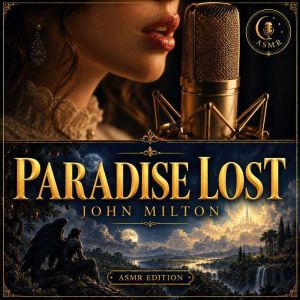
Paradise Lost
The Classic Book in a Soothing Voice – For Sleep and Meditation
Author: John Milton
Series: ASMR Classics
Narrator: AI Voice F. Nicole
Unabridged: 16 hr 6 min
Format: Digital Audiobook Download
Publisher: ASMR Classics
Published: 09/12/2026
Categories: Fiction, Poetry, Epic Poetry
Synopsis
This audiobook is narrated by an AI Voice.
In 1667, John Milton—blind, aging, and politically disgraced after the collapse of England’s republican experiment—completed Paradise Lost. Having spent years defending regicide and freedom of the press, he saw his political cause destroyed by the Restoration. He turned instead to poetry, creating an epic about humanity’s first disobedience and the problem at its heart: why would an all-powerful, benevolent God permit the Fall?
Milton builds a vast imaginative cosmos: Hell as “darkness visible,” Heaven with its angelic hierarchies, and Eden rendered in sensuous detail. At its center stands Satan, one of literature’s great villains—a fallen angel whose proud declaration, “Better to reign in Hell, than serve in Heaven,” initially gives him extraordinary grandeur. Yet that grandeur steadily collapses. His speeches reveal envy, self-deception, and an inability to repent; by Book IX, the rebel angel has become a serpent.
Milton’s blank verse—unrhymed iambic pentameter shaped by dense, Latinate syntax—is inseparable from the poem’s meaning. His winding sentences mirror Satan’s self-justifications, while the fractured language after the Fall reflects spiritual disorder.
A Note on This Edition - This edition is a modernization, not a translation. It offers access to the narrative and ideas for readers who find seventeenth-century English difficult, but simplification inevitably loses Milton’s rhythms, syntax, and verbal grandeur.
It can serve as an introduction or companion, but not an equivalent to the original. Paradise Lost ultimately deserves to be encountered in Milton’s own extraordinary verse.
In 1667, John Milton—blind, aging, and politically disgraced after the collapse of England’s republican experiment—completed Paradise Lost. Having spent years defending regicide and freedom of the press, he saw his political cause destroyed by the Restoration. He turned instead to poetry, creating an epic about humanity’s first disobedience and the problem at its heart: why would an all-powerful, benevolent God permit the Fall?
Milton builds a vast imaginative cosmos: Hell as “darkness visible,” Heaven with its angelic hierarchies, and Eden rendered in sensuous detail. At its center stands Satan, one of literature’s great villains—a fallen angel whose proud declaration, “Better to reign in Hell, than serve in Heaven,” initially gives him extraordinary grandeur. Yet that grandeur steadily collapses. His speeches reveal envy, self-deception, and an inability to repent; by Book IX, the rebel angel has become a serpent.
Milton’s blank verse—unrhymed iambic pentameter shaped by dense, Latinate syntax—is inseparable from the poem’s meaning. His winding sentences mirror Satan’s self-justifications, while the fractured language after the Fall reflects spiritual disorder.
A Note on This Edition - This edition is a modernization, not a translation. It offers access to the narrative and ideas for readers who find seventeenth-century English difficult, but simplification inevitably loses Milton’s rhythms, syntax, and verbal grandeur.
It can serve as an introduction or companion, but not an equivalent to the original. Paradise Lost ultimately deserves to be encountered in Milton’s own extraordinary verse.