List: $29.99
| Sale: $21.00
Club: $14.99
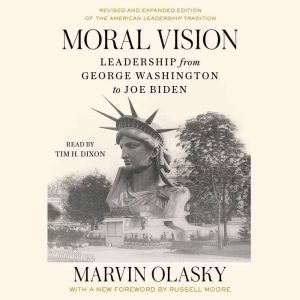
Moral Vision
Leadership from George Washington to Joe Biden
Author: Marvin Olasky
Narrator: Tim H. Dixon
Unabridged: 14 hr 38 min
Format: Digital Audiobook Download
Publisher: Simon & Schuster Audio
Published: 05/28/2024
Synopsis
What makes a leader truly great? Is it simply a matter of management style and personality? Or is it character that matters most? Moral Visions takes an insightful look into America’s leaders of the past to answer these questions and demonstrates that values and moral convictions are critical to the strength of a nation.
Supposedly, we learn about the candidates for the highest office through a series of tests called “debates,” which are instead an exchange of soundbites. We can’t know whether an aspirant to the presidency has the ability to ask good questions or only a suave or belligerent ability to answer them. Moral Vision is a human-interest introduction to American history through studies of nineteen leaders: presidents, almost presidents, a tycoon, a crusading journalist, and even a leading 19th century abortionist. Its lessons can help voters sort through the candidates in 2024 and beyond by measuring them against previous leaders—none of whom was faultless. It shows how the deepest views often grow out of religious belief and influence political goals, racial prejudices, sexual activities, uses of power, and senses of service.
In his 1789 inaugural address, George Washington pledged that “the foundation for national policy will be laid in the sure and immutable principles of private morality.” Marvin Olasky shows how 19th-century leaders like Thomas Jefferson, Andrew Jackson, and Grover Cleveland partly upheld and partly ignored that promise, and 20th-century leaders like Woodrow Wilson, John F. Kennedy, and Bill Clinton tried to “compartmentalize” the private and the public.
An extensively updated version of The American Leadership Tradition, Moral Vision is for anyone tired of today’s textbook tendencies to submerge the role of individuals as big economic and demographic waves roll in. History is more than statistics, economics, and group identities. Human beings are more than paper boats riding the rainfall into gutters.
Supposedly, we learn about the candidates for the highest office through a series of tests called “debates,” which are instead an exchange of soundbites. We can’t know whether an aspirant to the presidency has the ability to ask good questions or only a suave or belligerent ability to answer them. Moral Vision is a human-interest introduction to American history through studies of nineteen leaders: presidents, almost presidents, a tycoon, a crusading journalist, and even a leading 19th century abortionist. Its lessons can help voters sort through the candidates in 2024 and beyond by measuring them against previous leaders—none of whom was faultless. It shows how the deepest views often grow out of religious belief and influence political goals, racial prejudices, sexual activities, uses of power, and senses of service.
In his 1789 inaugural address, George Washington pledged that “the foundation for national policy will be laid in the sure and immutable principles of private morality.” Marvin Olasky shows how 19th-century leaders like Thomas Jefferson, Andrew Jackson, and Grover Cleveland partly upheld and partly ignored that promise, and 20th-century leaders like Woodrow Wilson, John F. Kennedy, and Bill Clinton tried to “compartmentalize” the private and the public.
An extensively updated version of The American Leadership Tradition, Moral Vision is for anyone tired of today’s textbook tendencies to submerge the role of individuals as big economic and demographic waves roll in. History is more than statistics, economics, and group identities. Human beings are more than paper boats riding the rainfall into gutters.


