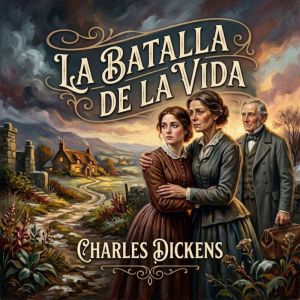
La Batalla de La Vida, Charles Dickens
List: $12.95 | Sale: $9.07
Club: $6.47

La Batalla de La Vida

Author: Charles Dickens

Narrator: AI Voice Cocota Audio

Unabridged: 4 hr 8 min

Format: Digital Audiobook Download

Published: 07/28/2026


Synopsis

This audiobook is narrated by an AI Voice. **La Batalla de la Vida**, de Charles Dickens, es una emotiva novela que invita a reflexionar sobre las luchas silenciosas que todas las personas enfrentan. A diferencia de los grandes conflictos que suelen captar la atención, esta obra recuerda que las batallas más importantes ocurren en el corazón: aquellas que implican renunciar al orgullo, perdonar, mantener la esperanza y actuar con generosidad incluso en los momentos más difíciles. Dickens retrata personajes profundamente humanos, capaces de equivocarse, sufrir y aprender, mostrando que la verdadera fortaleza nace de la compasión y del amor por los demás.

Desde una perspectiva de autoayuda, el libro ofrece una valiosa enseñanza sobre la resiliencia. Nos anima a comprender que no siempre podemos controlar las circunstancias, pero sí la forma en que respondemos a ellas. La capacidad de superar el dolor, conservar la dignidad y seguir adelante es presentada como una victoria mucho más significativa que cualquier éxito material.

En la actualidad, cuando el estrés, la incertidumbre y las exigencias diarias parecen dominar la vida de muchas personas, **La Batalla de la Vida** mantiene una sorprendente vigencia. Su mensaje nos recuerda que cada dificultad puede convertirse en una oportunidad para crecer, fortalecer nuestras relaciones y descubrir un propósito más profundo. Es una lectura cálida e inspiradora que demuestra por qué Charles Dickens sigue siendo uno de los grandes narradores de la condición humana, capaz de ofrecer enseñanzas que trascienden el tiempo y continúan iluminando el camino de nuevas generaciones de lectores.

About Charles Dickens

Charles Dickens was born on February 7, 1812, in Portsmouth, England, where his father was a naval pay clerk. When he was five, the family moved to Chatham, near Rochester, another port town. He received some education at a small private school but this was curtailed when his father's fortunes declined.

When Dickens was ten, the family moved to Camden Town, and this proved the beginning of a long, difficult period. When he had just turned twelve, Dickens was sent to work for a manufacturer of boot blacking, where for the better part of a year he labored for ten hours a day, an unhappy experience that instilled him with a sense of having been abandoned by his family. Around the same time Dickens's father was jailed for debt in the Marshalsea Prison, where he remained for fourteen weeks. After some additional schooling, Dickens worked as a clerk in a law office and taught himself shorthand; this qualified him to begin working in 1831 as a reporter in the House of Commons, where he became known for the speed with which he took down speeches.

By 1833 Dickens was publishing humorous sketches of London life in the Monthly Magazine, which were collected in book form as Sketches by "Boz". These were followed by the publication in installments of the comic adventures that became The Posthumous Papers of the Pickwick Club, whose unprecedented popularity made the twenty-five-year-old author a national figure. In 1836 he married Catherine Hogarth, who would bear him ten children over a period of fifteen years. Dickens's energies enabled him to lead an active family and social life, including an indulgence in elaborate amateur theatricals, while maintaining a literary productiveness of astonishing proportions. He characteristically wrote his novels for serial publication and was himself the editor of many of the periodicals in which they appeared, including Bentley's Miscellany, the Daily News, Household Words, and All the Year Round. Among his close associates were his future biographer John Forster and the younger Wilkie Collins, with whom he collaborated on fictional and dramatic works. In rapid succession he published Oliver Twist, Nicholas Nickleby, The Old Curiosity Shop, and Barnaby Rudge, sometimes working on several novels simultaneously.

Dickens's celebrity led to a tour of the United States in 1842. There he met Henry Wadsworth Longfellow, Washington Irving, William Cullen Bryant, and other literary figures, and was received with an enthusiasm that was dimmed somewhat by the criticisms Dickens expressed in his American Notes and in the American chapters of Martin Chuzzlewit. The appearance of A Christmas Carol in 1843 sealed his position as the most widely popular writer of his time; it became an annual tradition for him to write a story for the season, of which the most memorable were The Chimes and The Cricket on the Hearth. He continued to produce novels at only a slightly diminished rate, publishing Dombey and Son in 1848 and David Copperfield in 1850.

From this point on, his novels tended to be more elaborately constructed and harsher and less buoyant in tone than his earlier works. These late novels include Bleak House, Hard Times, Little Dorrit, A Tale of Two Cities, and Great Expectations. Our Mutual Friend, published in 1865, was his last completed novel and perhaps the most somber and savage of them all. Dickens had separated from his wife in 1858-he had become involved a year earlier with a young actress named Ellen Ternan-and the ensuing scandal had alienated him from many of his former associates and admirers. He was weakened by years of overwork and by a near-fatal railroad disaster during the writing of Our Mutual Friend. Nevertheless, he embarked on a series of public readings, including a return visit to America in 1867, which further eroded his health. A final work, The Mystery of Edwin Drood, a crime novel much influenced by Wilkie Collins, was left unfinished upon his death on June 9,1870, at the age of 58.


Reviews

There are currently no user reviews for this audiobook.