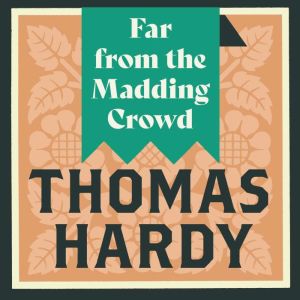
Far from the Madding Crowd, Thomas Hardy
List: $33.49 | Sale: $23.45
Club: $16.74

Far from the Madding Crowd

Author: Thomas Hardy

Narrator: Olivia Dowd

Unabridged: 14 hr 33 min

Format: Digital Audiobook Download

Publisher: SNR Audio

Published: 08/07/2024

Categories: Fiction, Classic


Synopsis

"And at home by the fire, whenever you look up, there I shall be—and whenever I look up, there will be you." Far From the Madding Crowd (1874) was Thomas Hardy's fourth novel and his first major success. Young, spirited, and ambitious, Bathsheba Everdene takes up her position as a farmer on the large estate in Weatherbury she has inherited from her uncle. Being forceful and independent, she makes a success of her new role despite her inexperience, and she attracts the attention of three very different suitors – wealthy gentleman farmer, Boldwood, dashing soldier and carefree womaniser Sergeant Troy, and the quietly devoted shepherd, Gabriel Oak. As Bathsheba navigates love, pride, and the unforgiving rhythms of country life, a series of impulsive choices leads to a tangled web of obsession, betrayal, and tragedy. Set against the backdrop of the seemingly idyllic, but often harsh, realities of a farming community in Victorian England, Far From the Madding Crowd deals in themes of love, honour and betrayal, and examines the struggles of a woman trying to maintain her independence while dealing with the social pressures of being a woman in a man's world. Thomas Hardy (1840–1928) was one of England's most influential novelists and poets, renowned for his vivid portrayals of rural life and the human struggle against social circumstances and constraint. Born in the Dorset hamlet of Higher Bockhampton, Hardy drew lifelong inspiration from the landscapes, dialects, and traditions of the region he later immortalized as Wessex. Although celebrated as an author of fiction, Hardy regarded himself primarily as a poet. His verse, much of it published later in life, blends emotional intensity with a deep awareness of history and the natural world, and was much acclaimed during his lifetime by writers including Siegfried Sassoon, Virginia Woof and W.B. Yeats. Today, Hardy's novels and poetry remain cornerstones of English literature, admired for their lyrical power, psychological depth, and enduring humanity.

About Thomas Hardy

Thomas Hardy (1840–1928) was an English poet and regional novelist whose works depict the county "Wessex," named after the ancient kingdom of Alfred the Great. Hardy's career as a writer spanned over fifty years, and his work reflected his stoic pessimism and sense of tragedy in human life.

Hardy was born in the village of Higher Bockhampton to a master mason. Hardy's mother, whose tastes included Latin poets and French romances, provided for his education. After schooling in Dorchester, Hardy was apprenticed to an architect. In 1874, Hardy married Emma Lavinia Gifford, for whom he wrote (after her death) a group of poems known as Veteris Vestigiae Flammae ("Vestiges of an Old Flame").

At the age of twenty-two, Hardy moved to London and started to write poems that idealized the rural life. An assistant in the architectural firm of Arthur Blomfield, Hardy visited art galleries, attended evening classes in French at King's College, enjoyed Shakespeare and opera, and read works of Charles Darwin, Herbert Spencer, and John Stuart Mills. In 1867 Hardy left London for the family home in Dorset. There, he continued his architectural career but started to consider literature his "true vocation."

Initially, Hardy did not find an audience for his poetry, and the novelist George Meredith advised Hardy to write a novel. The Poor Man and the Lady, written in 1867, was rejected by many publishers, and Hardy destroyed the manuscript. His first book to gain notice was Far from the Madding Crowd. After its success, Hardy was convinced that he could earn his living with his pen. Devoting himself entirely to writing, Hardy produced a series of novels, including Tess of the D'Urbervilles and Jude the Obscure, both of which met with public disapproval due to their unconventional subjects. This controversy led Hardy to announce that he would never write fiction again.

After giving up the novel, Hardy brought out a first group of Wessex poems, some of which had been composed thirty years before. During the remainder of his life, hecontinued to publish several collections of poems. Upon the death of his friend George Meredith, Hardy succeeded to the presidency of the Society of Authors in 1909. King George V conferred on him the Order of Merit, and in 1912 he received the gold medal of the Royal Society of Literature.

After Emma Hardy died, Thomas married his secretary, Florence Emily Dugdale. From 1920 through 1927 Hardy concentrated on his autobiography, which was disguised as the work of Florence Hardy. It appeared in two volumes. Hardy's last book was Human Shows, Far Phantasies, Songs and Trifles. His Winter Words in Various Moods and Metres appeared posthumously in 1928. Hardy died in Dorchester, Dorset, on January 11, 1928.


Reviews

There are currently no user reviews for this audiobook.