1 Rating(s)
List: $16.99
| Sale: $11.89
Club: $8.49
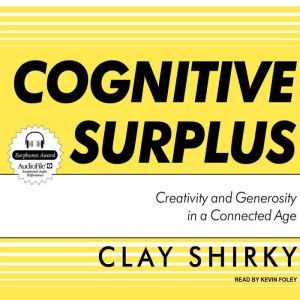
Cognitive Surplus
Creativity and Generosity in a Connected Age
Author: Clay Shirky
Narrator: Kevin Foley
Unabridged: 6 hr 50 min
Format: Digital Audiobook Download
Publisher: Tantor Media
Published: 06/10/2010
Categories: Nonfiction, Business & Economics, Management & Leadership
Synopsis
For decades, technology encouraged people to squander their time and intellect as passive consumers. Today, technology has finally caught up with human potential. In Cognitive Surplus, Internet guru Clay Shirky forecasts the thrilling changes we will all enjoy as new digital technology puts our untapped resources of talent and goodwill to use at last.
Since we Americans were suburbanized and educated by the postwar boom, we've had a surfeit of intellect, energy, and time—what Shirky calls a cognitive surplus. But this abundance had little impact on the common good because television consumed the lion's share of it—and we consume TV passively, in isolation from one another. Now, for the first time, people are embracing new media that allow us to pool our efforts at vanishingly low cost. The results of this aggregated effort range from mind expanding—reference tools like Wikipedia—to lifesaving, such as Ushahidi.com, which has allowed Kenyans to sidestep government censorship and report on acts of violence in real time.
Shirky argues persuasively that this cognitive surplus—rather than being some strange new departure from normal behavior—actually returns our society to forms of collaboration that were natural to us up through the early twentieth century. He also charts the vast effects that our cognitive surplus—aided by new technologies—will have on twenty-first-century society, and how we can best exploit those effects. Shirky envisions an era of lower creative quality on average but greater innovation, an increase in transparency in all areas of society, and a dramatic rise in productivity that will transform our civilization.
The potential impact of cognitive surplus is enormous. As Shirky points out, Wikipedia was built out of roughly 1 percent of the man-hours that Americans spend watching TV every year. Wikipedia and other current products of cognitive surplus are only the iceberg's tip. Shirky shows how society and our daily lives will be improved dramatically as we learn to exploit our goodwill and free time like never before.
Since we Americans were suburbanized and educated by the postwar boom, we've had a surfeit of intellect, energy, and time—what Shirky calls a cognitive surplus. But this abundance had little impact on the common good because television consumed the lion's share of it—and we consume TV passively, in isolation from one another. Now, for the first time, people are embracing new media that allow us to pool our efforts at vanishingly low cost. The results of this aggregated effort range from mind expanding—reference tools like Wikipedia—to lifesaving, such as Ushahidi.com, which has allowed Kenyans to sidestep government censorship and report on acts of violence in real time.
Shirky argues persuasively that this cognitive surplus—rather than being some strange new departure from normal behavior—actually returns our society to forms of collaboration that were natural to us up through the early twentieth century. He also charts the vast effects that our cognitive surplus—aided by new technologies—will have on twenty-first-century society, and how we can best exploit those effects. Shirky envisions an era of lower creative quality on average but greater innovation, an increase in transparency in all areas of society, and a dramatic rise in productivity that will transform our civilization.
The potential impact of cognitive surplus is enormous. As Shirky points out, Wikipedia was built out of roughly 1 percent of the man-hours that Americans spend watching TV every year. Wikipedia and other current products of cognitive surplus are only the iceberg's tip. Shirky shows how society and our daily lives will be improved dramatically as we learn to exploit our goodwill and free time like never before.


