About Voltaire
Francois Marie Arouet (pen name Voltaire) was born on November 21, 1694, in Paris. Voltaire's intelligence, wit, and style made him one of France's greatest writers and philosophers.
Young Francois Marie received his education at Louis-le-Grand, a Jesuit college in Paris, where he said he learned nothing but "Latin and the Stupidities." He left school at age seventeen and soon made friends among the Parisian aristocrats. His humorous verses made him a favorite in society circles. In 1717, his sharp wit got him into trouble with the authorities. He was imprisoned in the Bastille for eleven months for writing a scathing satire of the French government. During his time in prison Francois Marie wrote Oedipe, which was to become his first theatrical success, and also adopted his pen name.
In 1726, Voltaire insulted the powerful young nobleman Chevalier De Rohan and was given two options: imprisonment or exile. He chose exile, and from 1726 to 1729 lived in England. While in England, Voltaire was attracted to the philosophy of John Locke and the ideas of the mathematician and scientist Sir Isaac Newton. He studied England's Constitutional Monarchy and its religious tolerance. Voltaire was particularly interested in the philosophical rationalism of the time and in the study of the natural sciences. After returning to Paris, he wrote a book praising English customs and institutions. It was interpreted as criticism of the French government, and in 1734 Voltaire was forced to leave Paris again.
At the invitation of the Marquise du Chatelet, Voltaire moved into her Chateau de Cirey near Luneville in eastern France. They studied the natural sciences together for several years. In 1746, Voltaire was voted into the Academie Francaise. In 1749, after the death of the Marquise du Chatelet, he moved to Potsdam (near Berlin in Germany). In 1753, Voltaire left Potsdam to return to France.
In 1759, Voltaire purchased an estate called "Ferney" near the French-Swiss border, where he lived until just before his death. Ferney soon became the intellectual capital of Europe. Voltaire worked continuously throughout the years, producing a constant flow of books, plays, and other publications. He wrote hundreds of letters to his circle of friends. He was always considered a voice of reason. Voltaire was often an outspoken critic of religious intolerance and persecution.
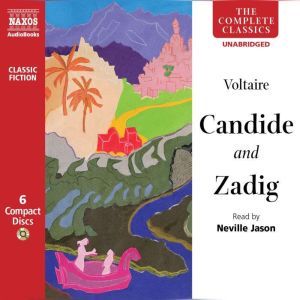
Voltaire returned to a hero's welcome in Paris at age eighty-three. The excitement of the trip was too much for him, and he died in Paris in 1778. Among the major works Voltaire gave to the world are Zadig, a philosophical story of religious and metaphysical orthodoxy, and one of his most celebrated works; "Micromegas," a short story whose ideas helped to create the genre of science fiction; the French satire Candide, which is considered Voltaire's master work; and the Dictionnaire Philosophique, a lifelong project that represents the culmination of Voltaire's views on Christianity, God, morality, and other subjects.