List: $6.99
| Sale: $4.90
Club: $3.49
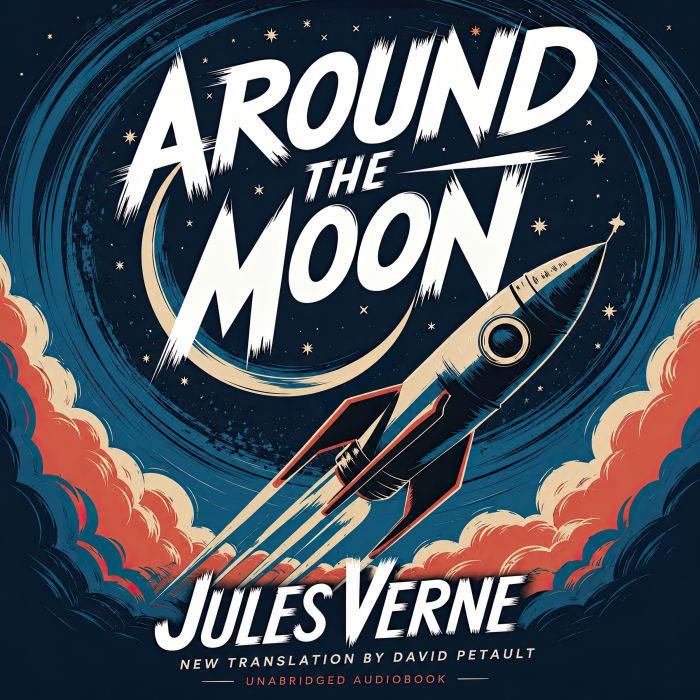
Around The Moon
Author: Jules Verne
Narrator: AI Voice Charles Owen
Unabridged: 6 hr 52 min
Format: Digital Audiobook Download
Publisher: Independently Published
Published: 07/07/2026
Categories: Fiction, Science Fiction, World Literature
Synopsis
This audiobook is narrated by an AI Voice. The cannon has fired. The projectile is in motion. And now, sealed inside their metal shell with a dog, three bottles of champagne, and an alarming number of unanswered questions, Impey Barbicane, Michel Ardan, and Captain Nicholl are hurtling through space toward the Moon — or rather, as a passing meteor is about to make clear, toward something in the approximate vicinity of the Moon.
Around the Moon, published in 1870 as the conclusion of the story begun in From the Earth to the Moon, is Jules Verne at his most scientifically serious and his most quietly honest. His three travelers observe the lunar surface through their portholes, calculate their trajectory, argue about philosophy, eject their dead dog through a porthole into permanent orbit, and discover — when the moment of landing arrives — that they will not be landing. The deviation from their planned course means they will circle the Moon and return to Earth, watching the surface they came to reach recede behind them.
This is not a failure. It is Verne refusing to invent a solution to a problem he had not solved — the problem of how a projectile without independent propulsion could decelerate enough to land — and choosing the honest ending over the triumphant one. They orbit. They observe. They return. They splash down in the Pacific and are recovered by an American naval vessel in a sequence so close to the actual procedures of the Apollo program, conducted ninety-nine years later, that the parallel has never stopped astonishing the people who notice it.
Precise, contemplative, and more interested in the texture of the journey than the glory of arrival — the rare sequel that deepens everything the first novel began.
Around the Moon, published in 1870 as the conclusion of the story begun in From the Earth to the Moon, is Jules Verne at his most scientifically serious and his most quietly honest. His three travelers observe the lunar surface through their portholes, calculate their trajectory, argue about philosophy, eject their dead dog through a porthole into permanent orbit, and discover — when the moment of landing arrives — that they will not be landing. The deviation from their planned course means they will circle the Moon and return to Earth, watching the surface they came to reach recede behind them.
This is not a failure. It is Verne refusing to invent a solution to a problem he had not solved — the problem of how a projectile without independent propulsion could decelerate enough to land — and choosing the honest ending over the triumphant one. They orbit. They observe. They return. They splash down in the Pacific and are recovered by an American naval vessel in a sequence so close to the actual procedures of the Apollo program, conducted ninety-nine years later, that the parallel has never stopped astonishing the people who notice it.
Precise, contemplative, and more interested in the texture of the journey than the glory of arrival — the rare sequel that deepens everything the first novel began.