List: $6.95
| Sale: $4.87
Club: $3.47
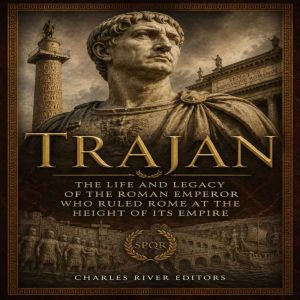
Trajan: The Life and Legacy of the Roman Emperor Who Ruled Rome at the Height of Its Empire
Author: Charles River Editors
Narrator: Roger Blake
Unabridged: 1 hr 43 min
Format: Digital Audiobook Download
Publisher: Charles River Editors
Published: 05/18/2026
Categories: Nonfiction, History, Roman History, Ancient History, World History
Synopsis
Trajan has been considered one of the greatest and best-known of all Roman emperors, and not simply because the Roman Empire reached its greatest extent during his 19-year reign. In addition to his military achievements, he also developed the administration of the government so successfully that his relationships with the Senate and the people were extraordinarily positive. Cassius Dio would write of him, “His association with the people was marked by affability and his intercourse with the Senate by dignity so that he was loved by all and dreaded by none save the enemy.” Perhaps one of the most unusual steps taken by Trajan, one that added to his popularity and reputation, was his scheme to help the poor and children in particular. He set imperial funds, known as alimenta, aside to provide for their upkeep. The policy lasted for nearly 200 years. While he was unquestionably a capable administrator, Trajan’s military successes account for the way his contemporaries and history hold him in high esteem. He excelled in the art of war, and his bravery and willingness to share in the trials and tribulations of his troops endeared him to them. Trajan set the standard by which future emperors were judged, and his reputation lasted so long that during the Middle Ages, Dante gave him a place in Heaven, something that was not done for other pre-Christian emperors. Today, Trajan is remembered as one of the “Five Good Emperors,” a reference to the five emperors who ruled the Roman Empire between 96 and 180 CE (Nerva, Trajan, Hadrian, Antoninus Pius, and Marcus Aurelius). The term was first coined by Machiavelli and later adopted and popularized by historian Edward Gibbon, who said that under these men, the Roman Empire “was governed by absolute power under the guidance of wisdom and virtue.” This period of 84 years is generally regarded as the high point of the Roman Empire, at least after Augustus,